
Architects and designers want healthier, lower-impact products. The real challenge is giving them the proof, tools, and protection required to carry those products from material library to completed project.
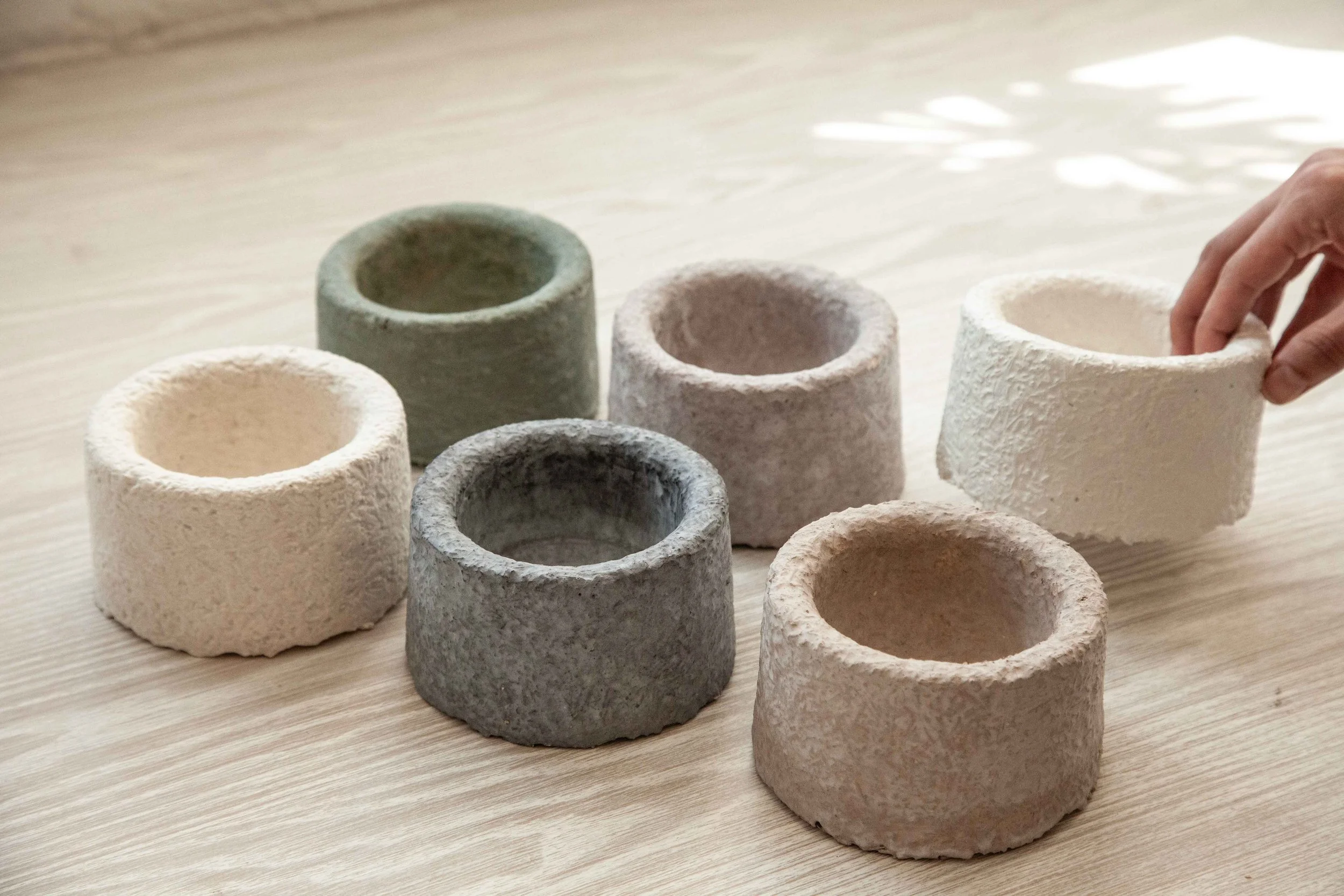
MushLume mycelium and hemp composite material samples
For more than twelve years, MushLume has worked to move mycelium from an experimental material into functional lighting and acoustic products for real interiors.
During that time, interest in biomaterials has grown tremendously. Architects and designers are actively searching for healthier materials, lower embodied carbon, greater transparency, and alternatives to petrochemical products. Material libraries are expanding. Sustainability commitments have become more ambitious. Clients are increasingly aware that the materials surrounding us affect both planetary and human health.
Yet an important gap remains between interest and adoption.
A bio-based product can be admired in a showroom, selected by the designer, and written into a specification, only to disappear before installation.
This does not happen because architects and designers lack interest. Research suggests that 79 percent of architects want to specify more sustainable materials. At the same time, only 17 percent of architecture and design professionals rank sustainability among their three most important product-selection factors. Performance, cost, availability, risk, and ease of doing business still determine what ultimately gets purchased.
That is the central challenge facing the biomaterials industry. We do not simply need to make better materials. We need to make those materials easier to understand, safer to specify, harder to substitute, and more practical to purchase.

A cluster of mycelium-grown pendants in the lobby of The Stokely, a multi-family residential building in Washington state. Image courtesy of Rob Frost/Chance Productions
Sustainability May Open the Door, but It Rarely Closes the Sale
“When I first began working with mycelium, explaining the material was often the primary challenge. Most people had never heard of mycelium, much less considered it a viable material for lighting or interiors” founder, Danielle Trofe explains.
Today, awareness is no longer the only obstacle. Many architects and designers already understand the environmental potential of grown materials. They are intrigued by mycelium’s ability to bind agricultural fibers into solid forms without synthetic resins. They appreciate its natural texture, low-energy growing process, and potential for a compostable end of life.
But professional specification involves more than believing in the material.
A designer may love a product, but the lighting consultant needs technical information. The architect needs fire and material documentation. The contractor needs installation instructions. The purchasing agent needs reliable pricing and lead times. The client needs confidence that the manufacturer will still be available if something must be replaced.
Every participant is asking a different version of the same question:
Can I defend this decision?
Until the answer is yes, the familiar product usually wins.

Hand-forming hemp and mycelium substrate into sustainable lampshades
Barrier One: Good Intentions Cannot Replace Technical Proof
Sustainable material selection has become increasingly data-driven. Large architecture firms, public agencies, hospitality brands, and certification programs need information that can be incorporated into project documentation and compared with conventional alternatives.
According to an NBS survey, 92 percent of specifiers believe manufacturers need to provide more sustainability performance data. For acoustic products, consultants have also identified a shortage of integrated information that brings acoustic performance, durability, and environmental credentials together.
For bio-based lighting and acoustics, this proof may include:
Fire-performance testing (ASTM E84)
Acoustic testing for specific configurations (ASTM C423)
Complete electrical safety listings (UL or ETL listed)
VOC and material-health information (DECLARE)
Environmental product declarations (EPD)
Material composition and sourcing information
Installation and maintenance instructions
Product warranties
BIM, CAD, and photometric files
Capacity, lead-time, and dimensional-tolerance information
The need for this documentation is understandable. Architects and designers are responsible for creating spaces that must meet codes, budgets, schedules, performance requirements, and client expectations.
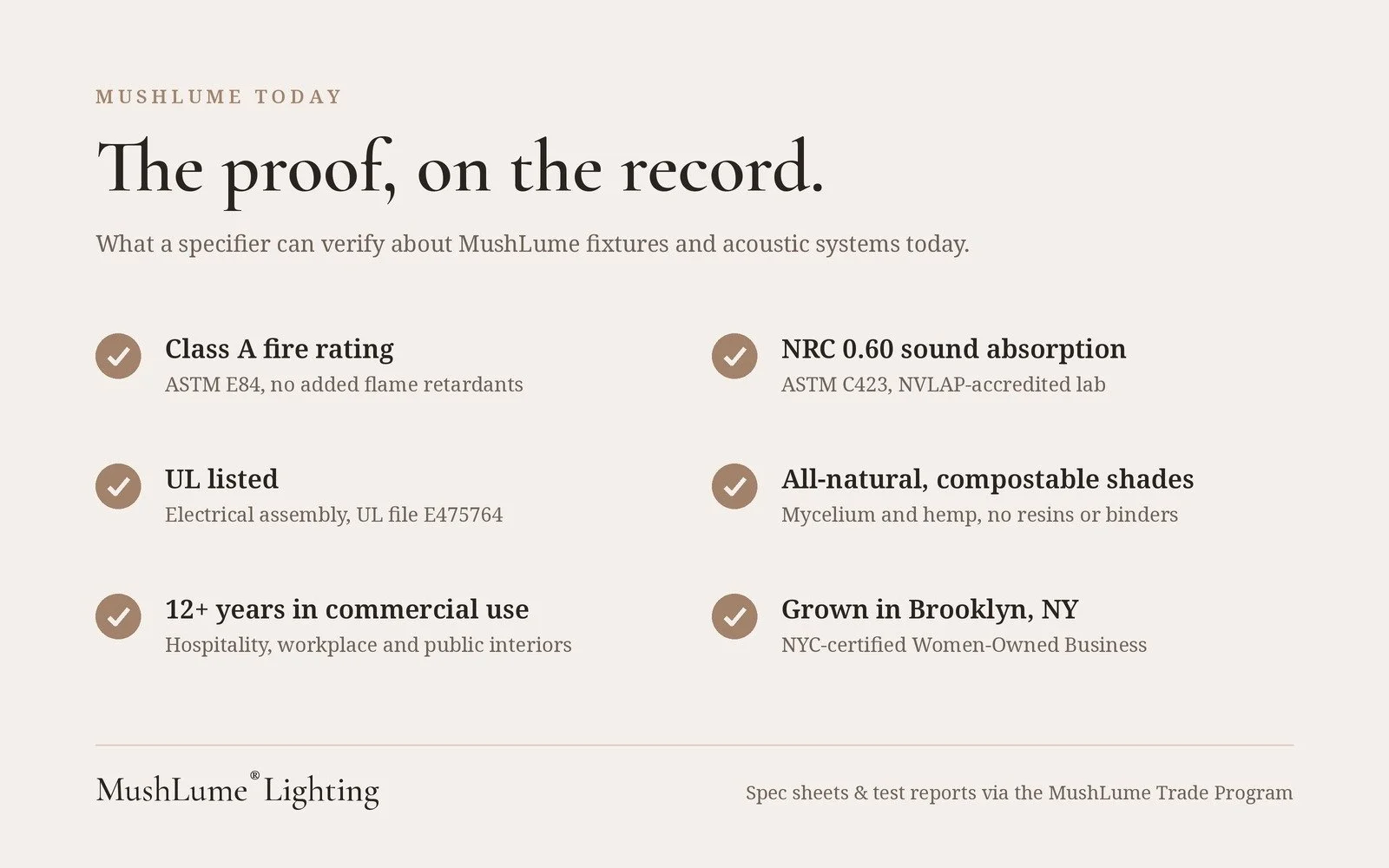
The difficulty is that the cost of proving a new material can be substantial, particularly for a small manufacturer. A single environmental product declaration can cost tens of thousands of dollars. Electrical listings, fire testing, acoustic testing, emissions testing, and digital assets each require additional investment.
This creates a difficult industry paradox: manufacturers often need commercial volume to pay for testing, while specifiers need testing before they can confidently create that volume.
Public funding, paid pilots, collaborative testing programs, and early-adopter projects can help close this gap. If the design industry wants more material innovation, it must help create pathways through which emerging manufacturers can generate the proof required for adoption.
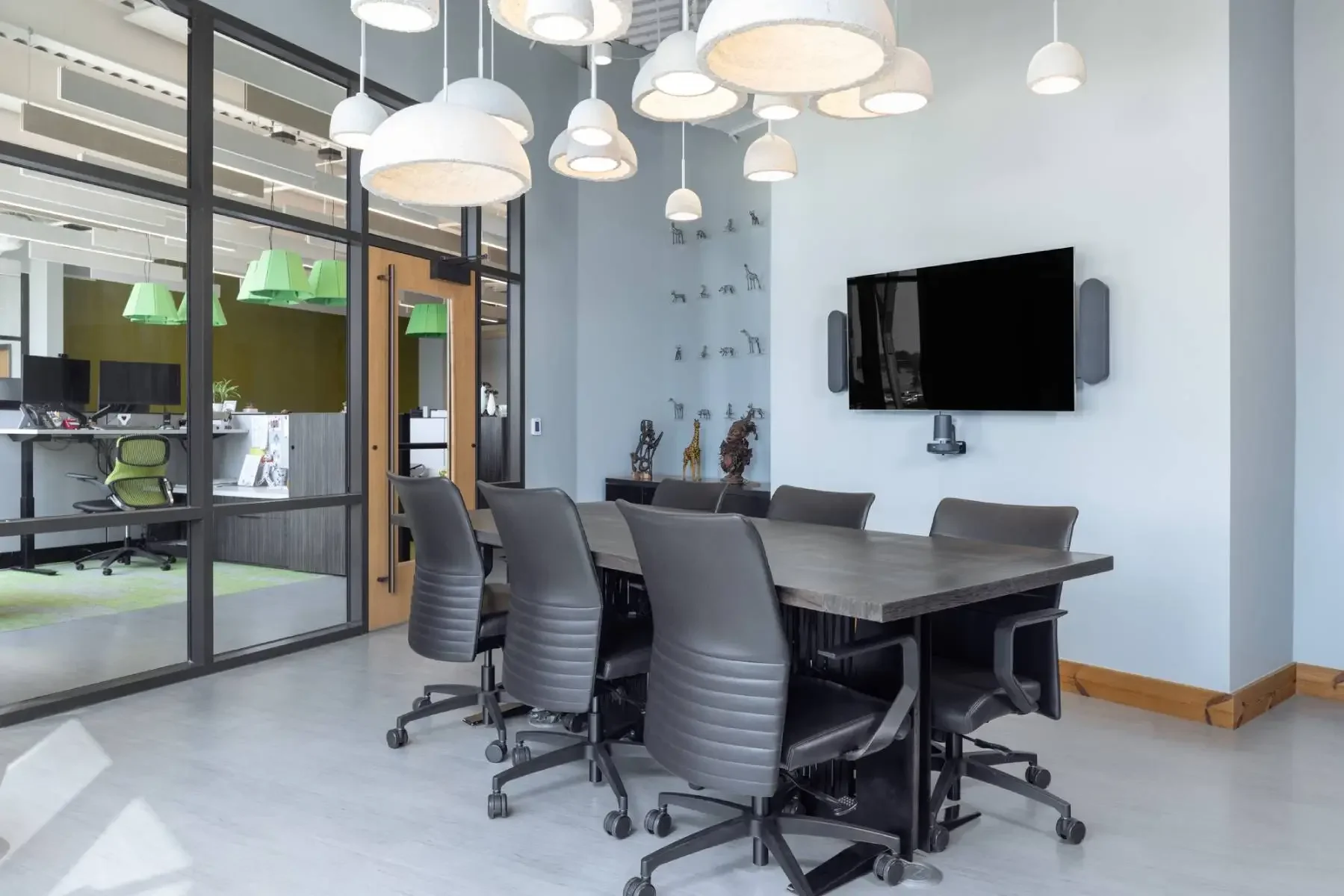
Biofabricated lighting hanging over a conference table in the Oklahoma City Zoo administrative building. Photography: Mel Willis
Barrier Two: Novelty Creates Risk for the Specifier
Design professionals are trained to evaluate risk. The more unfamiliar a material is, the more diligence its selection can require.
A conventional acoustic panel may not inspire much curiosity, but its installation system, fire rating, acoustic data, warranty, and supply chain are already understood. The manufacturer may have decades of completed projects behind it.
A mycelium product asks the project team to consider something new.
Will it remain stable? Is it still alive? Will it grow mushrooms or release spores? How does it respond to humidity? Can the manufacturer reproduce it consistently? What happens if a piece is damaged? Can the material be supplied at the required scale?
Some of these questions arise from misconceptions; however, others reflect legitimate technical considerations. Natural materials respond to moisture, and biofabricated products can carry variations in color, texture, density, and dimensions. Durability is also an understandable concern, particularly when a product is designed to be compostable at the end of its useful life. But durability in use and responsible end of life are not opposing goals. A well-designed bio-based product should remain stable within its intended interior environment, then break down only when it is removed from service and placed under the moisture, microbial, and other conditions required for decomposition. The responsibility of the manufacturer is to test those boundaries, communicate appropriate applications and maintenance, and provide evidence that the product will perform for its intended lifespan.
Industry leadership requires addressing those realities directly.
Rather than presenting biomaterials as perfect replacements for every application, manufacturers should clearly communicate where their products perform well, where they should not be installed, how they should be stored, and what degree of natural variation should be expected.
Credibility is not created by eliminating every limitation. It is created by understanding those limitations, designing around them, and communicating them transparently.
Track record also matters. For MushLume, more than twelve years of production and installations across residential, hospitality, restaurant, workplace, and public environments are not simply part of our history. They are evidence that a biofabricated product can move beyond the prototype stage and operate within the demands of real projects.
The next step for our industry is to document these applications more rigorously through mock-ups, case studies, installation records, condition checks, and long-term performance observations.

1 Hotel Brooklyn Bridge, Riverhouse Suite, 2017. Nearly a decade after installation, this custom MushLume lighting installation remains in active hospitality use, demonstrating the long-term durability of mycelium-based materials in a commercial interior. Photography by SH Hotels & Resorts.
Barrier Three: Bio-Based Products Are Still Evaluated Through Price Alone
This pressure becomes especially visible during value engineering.
Bio-based products are often compared directly with mass-produced alternatives without considering whether those products deliver the same combination of benefits. A dual-function acoustic light may be compared only with the cost of a conventional fixture, without including the acoustic treatment or sculptural feature it can also replace. A finished acoustic wall system may be compared only with the least expensive sound absorber, without considering additional finishes, adhesives, labor, material health, or end-of-life impacts.
This is not an argument that sustainable products should be exempt from budget scrutiny. They must offer credible value and perform within commercial realities. But our definition of value must become more complete.
Does the product combine several functions? Does it reduce the number of material layers required? Does it support healthier indoor environments? Can individual components be replaced rather than discarding the entire fixture or acoustic solution? Does local or domestic production reduce supply-chain exposure? What environmental or disposal costs are simply absent from the purchase price of the conventional alternative?
Sustainable manufacturers also need to offer options within their own systems. If a project faces budget pressure, the response should not always be to remove the bio-based product entirely. A simpler finish, standard size, alternate configuration, or phased installation may preserve the material intent while bringing the project closer to its target.
The goal is to make value engineering a conversation about value, not merely a search for the lowest first cost.

Absorbing sound while illuminating the space, MushLume acoustic lighting addresses two essential interior needs with one multifunctional solution, helping streamline project costs without compromising sustainability.
Barrier Four: Being Specified Does Not Mean Being Installed
One of the most damaging barriers occurs after the design work has already been completed.
A designer may spend years discovering a product, requesting samples, developing a relationship with its manufacturer, presenting it to the client, and incorporating it into the project. Late in the process, the specified product can be replaced by a less expensive or more familiar alternative.
Research from the AIA and Associated General Contractors found that more than half of architects believe contractor substitutions do not always serve the client’s best interests. In complex lighting schedules, value-engineering exercises can replace large portions of the originally specified package.
For a large manufacturer, one lost specification is disappointing. For a small material innovator, repeated substitutions can prevent the company from generating the revenue, scale, performance history, and documentation the industry says it needs.
This creates another circular problem: The product is considered risky because it lacks a long commercial track record, but the projects that would build that track record are removed before installation.
Protecting material innovation requires clearer basis-of-design specifications, meaningful substitution criteria, early cost alignment, owner involvement, and more direct communication between designers and manufacturers.
It may also require different purchasing pathways. In some hospitality and commercial projects, direct or owner-furnished purchasing can help preserve a distinctive lighting or acoustic product rather than placing it inside a larger commodity bid package where first cost becomes the dominant criterion.
If sustainability goals are expected to survive construction, they must be protected contractually and financially, not simply expressed during concept design.
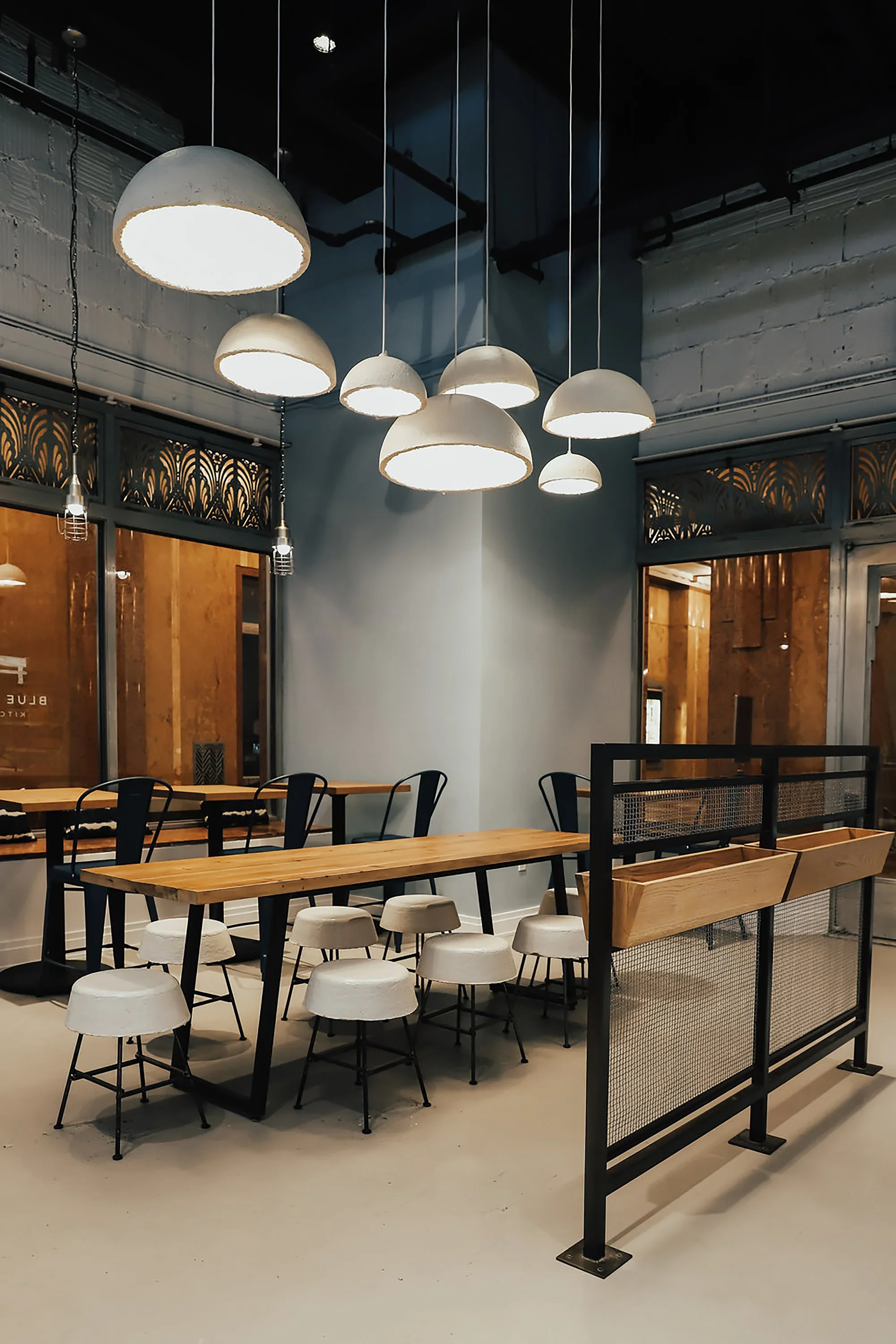
MushLume pendants bring natural texture and warmth to Blue Park Kitchen’s modern interior. First installed at the restaurant’s original location in 2018, the lighting became part of the brand’s evolving design language, leading to a second MushLume installation in 2021.
Barrier Five: Bio-Based Materials Must Be Experienced, Not Only Explained
Mycelium carries an additional challenge because it is unfamiliar and biologically derived.
In one small study of architects and designers, 98 percent of participants found mycelium visually attractive, but only 40 percent were familiar with it as a potential building material. Other research suggests that physical interaction and additional information can improve acceptance.
“This aligns closely with what I have observed over twelve years. When people first hear mushroom material, they may imagine something soft, wet, fragile, or temporary. When they hold a finished MushLume sample, feel its density and weight, see its structure, and understand that it has been dried and stabilized, the conversation changes.”
Touch turns an abstract biomaterial into a possible product.
This is why samples, material libraries, mock-ups, studio visits, trade exhibitions, and pilot installations matter so much. Digital data is essential, but it cannot fully communicate the tactile and sensory qualities that make natural materials compelling in an interior.
A specification strategy for biomaterials needs both evidence and experience.

Founder Danielle Trofe demonstrating the strength and soft texture of a mycelium-grown lampshade during a studio visit in Brooklyn, NY
From Material Interest to Material Confidence
Manufacturers have an important responsibility in closing the adoption gap.
We need to provide clear, accessible information rather than expecting a designer to assemble it from multiple sources. We need responsive trade programs, samples, realistic lead times, transparent limitations, installation guidance, technical documentation, and clear pathways for requesting custom work.
At MushLume, we are continuing to strengthen that infrastructure around our lighting and acoustic systems. This includes expanding our trade resources, organizing technical assets, pursuing additional testing and certification, creating clearer specification information, and developing commercial acoustic systems that integrate sound absorption, natural materiality, and, in selected applications, illumination.
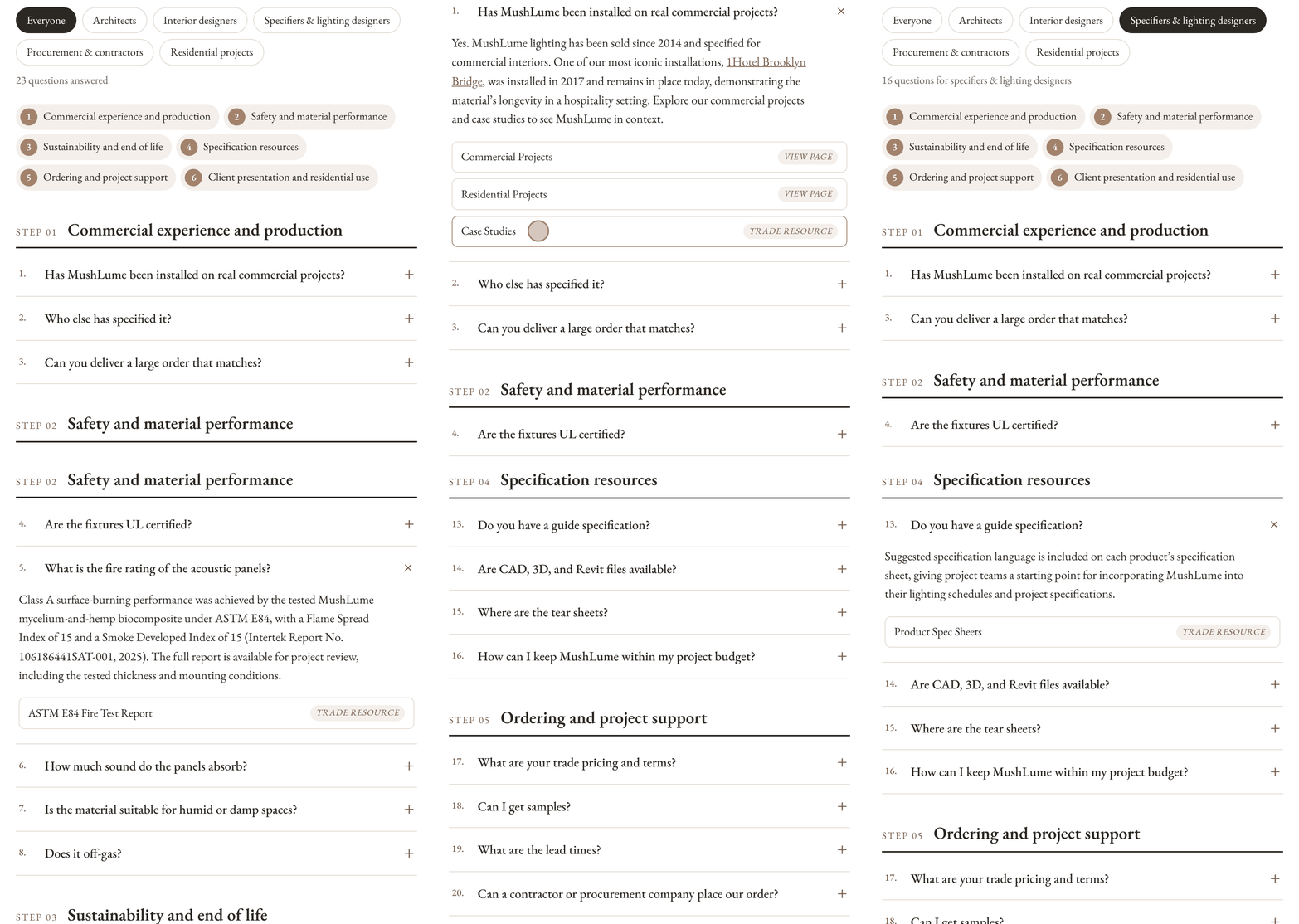
We have also developed an interactive trade resource to help identify the information different project participants need to make a confident material decision. An interior designer, lighting consultant, sustainability lead, contractor, and purchasing agent may all be evaluating the same product, but they are not evaluating it through the same lens.
Available to MushLume Trade Members. Not a Member? Apply today!
Making those needs visible earlier can reduce uncertainty later. The design industry also has a role to play.
Architects and designers can bring manufacturers into projects before budgets and specifications are fixed. Owners can support mock-ups and paid pilots. Contractors can evaluate substitutions against the complete performance and sustainability criteria rather than appearance and price alone. Institutions can help small manufacturers access testing, pilot sites, and procurement opportunities. Material libraries can connect discovery with the technical resources required for specification.
The transition to healthier materials cannot rest entirely on the small companies developing them.
Proof, Not Passion, Will Move the Industry Forward
The biomaterials industry has spent years proving that we can grow compelling new materials from mycelium, agricultural fibers, plants, algae, bacteria, and other biological systems. The next challenge is proving that these materials can perform, scale, and move reliably through the systems that shape the built environment.
Passion attracts attention. A beautiful sample begins the conversation. A powerful environmental story may earn a place in the material library. But proof earns the specification. Ease of use keeps the product in the project. And successful installations build the confidence that allows the next architect, client, contractor, or public agency to say yes.
If we want bio-based lighting and acoustics to become part of everyday interiors, the industry must invest in more than invention. We must build the documentation, partnerships, pilot opportunities, and procurement pathways that move innovation from the material table into the spaces where people live, work, gather, and heal.
That is how an emerging material becomes an industry.

Cluster of MushLume flushmount acoustic lamps provides sound absorption, light and art to this multi-family residential multi-purpose space.
Why This Conversation Matters at Greenbuild
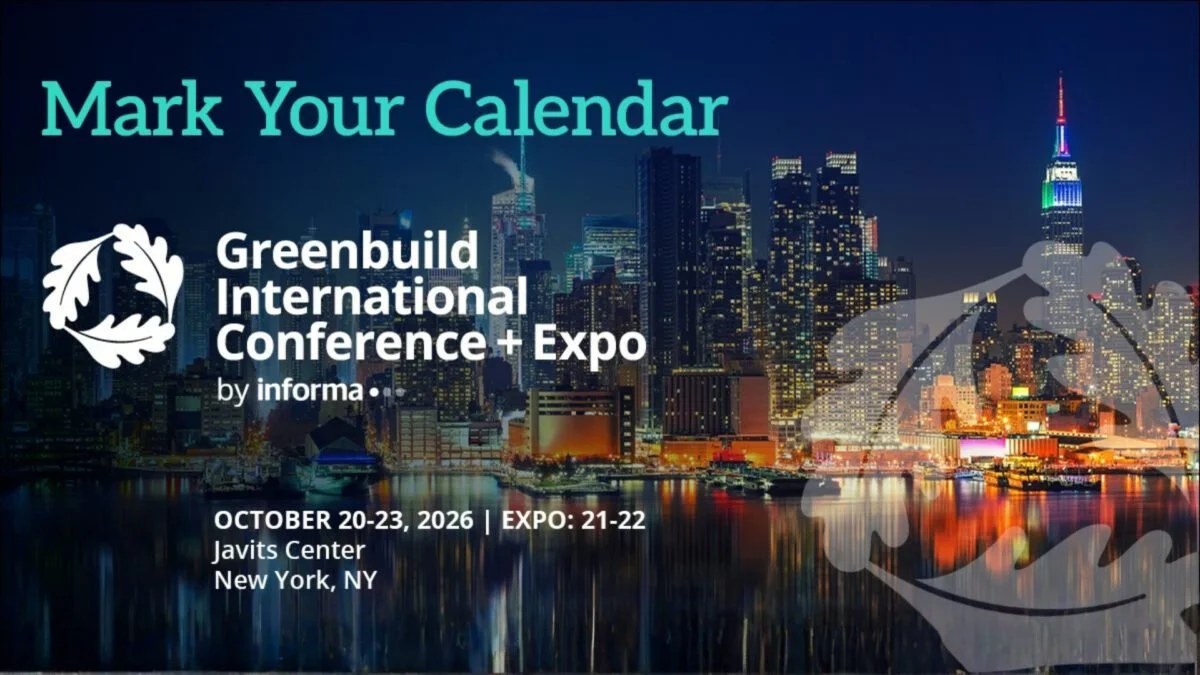
This week, the green building industry comes together at Greenbuild 2026 at the Javits Center in New York. The conference’s theme, Invest for Impact, focuses on turning sustainability commitments into measurable outcomes across new construction and existing buildings.
For us, this participation is about more than exhibiting a finished object. It is an opportunity for architects, designers, manufacturers, and sustainability professionals to encounter a biofabricated material physically and consider what would be required to bring it into their own projects.
Greenbuild gathers many of the people who influence whether sustainable products advance from aspiration to implementation. That makes it an appropriate place to ask a more difficult question: Are we investing only in discovering new materials, or are we also investing in the testing, infrastructure, procurement pathways, and early projects that allow those materials to succeed?
Innovation needs visibility, but visibility is not enough. It needs a route into the specification and protection through installation.
Our New Trade Tools & Resources
Everything you need to specify MushLume, in one place.
Our new Trade Q&A answers the questions architects, designers, specifiers and procurement teams ask most, each linked to the spec sheet, test report or resource behind it. Filter by your role, open an answer, and download what your project needs.
Start using our new trade tools and resources today!